
The Boardroom Game
An interactive boardroom simulation for economics and business students. Students take a seat on the board of a company and run it together. They steer profit, sustainability and innovation through good and bad quarters, and they answer for the results.
At a glance
8 rounds
Eight rounds plus a practice round, in one session of about two hours. The instructor can set 4 to 12 rounds.
3 mandates
Each board plays for profit, ESG or R&D. The matching score counts 1.25 times when it is positive.
6 different shocks
One shock per game, in round 4, 5 or 6, drawn from the shocks the instructor allows. Examples are a recession and a resource crisis.
Small boards
One CEO per board, chosen at random. The other members advise and challenge.
In the browser
Participants play in the web browser on their own laptop, tablet or phone. Nothing to install.
Small and large classes
All boards play at the same time, from a small seminar to a large class.
How it works
The game divides the students at random into small boards, called groups in the game. Every board runs its own copy of the same company, Giant Rubber Corporation. Boards do not affect each other’s markets. They compete only in the standings. Behind the game is a standard economic production model with labour, capital and resources. Each board gets a shareholder mandate that gives extra weight to profit, ESG or R&D. The scoring is balanced so that no mandate gives a board an advantage. After a practice round, every round follows four steps.

Step 1
Discuss and decide
Within a time limit, the CEO divides a fixed budget over five levers. These are wages, resources, capital investment, capital R&D and resource R&D. Board members see the plan update live and give advice.
Step 2
Results
The game calculates output and the profit, ESG and R&D scores of each board.
Step 3
Standings
All boards see the ranking by total score so far.
Step 4
Memo
Each board reads tips from the Chief of Staff and a note from the Supervisory Board. Then the next round starts.
Shock round
News flash
Before the shock round, a newspaper front page announces the shock. The shock changes the conditions for that round only.
For your classroom
The game turns textbook concepts into decisions that students must defend. Students experience diminishing returns, capital that wears out and R&D that builds up over several rounds. They also see what ESG choices cost. A closing discussion looks at how the mandates shaped the choices of each board. The game fits courses in microeconomics, corporate finance, strategy, sustainability and behavioural economics. It also suits MBA electives, executive education, and recruitment and assessment.
One instructor runs the whole session from a single dashboard. Before the game, the instructor sets the number of boards and players, the number of rounds, the time per round and which shocks can occur. The game assigns the mandates at random. During the game, the instructor sees who is online and which boards have submitted, and controls the pace. Players also fill in short questionnaires before, midway and after the game.
The annual university licence costs €9,500. It includes unlimited sessions for one academic year and browser access for every student. It also includes an anonymised export of the results (CSV) for grading and research, a teaching guide, an onboarding session, email support and software updates during the year.
The Boardroom Game is developed by SEO Amsterdam Economics and Reward Value, with support from the Goldschmeding Foundation.
Brochure and demo
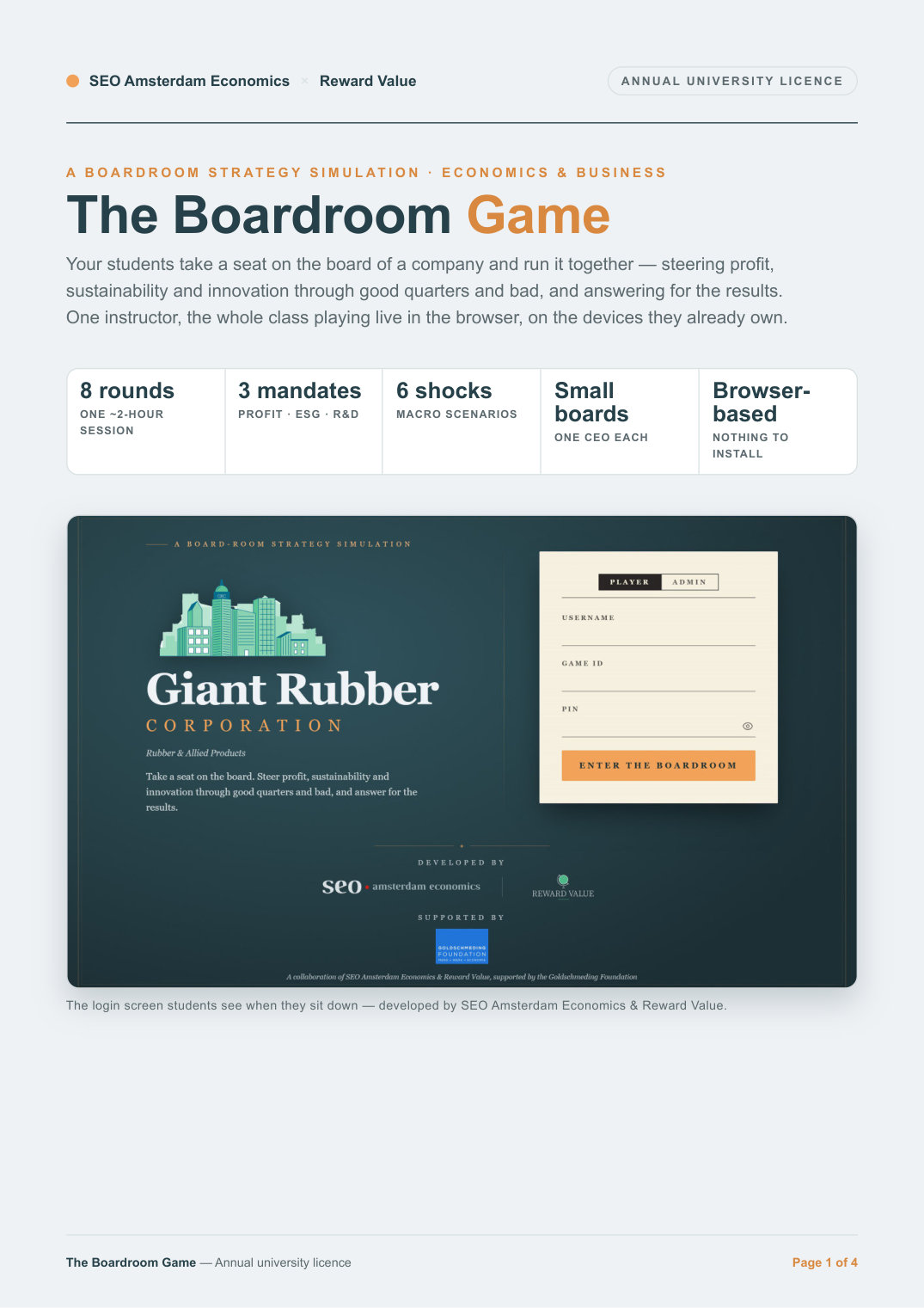
The brochure gives a full overview of the game, the learning goals and the licence.
Would you like to see the game in action? Book a free 30-minute demo with your team and run a pilot with one of your classes. After the pilot, you can activate the licence for your department. Contact frederic.barge@rewardvalue.org or j.witteman@seo.nl.